
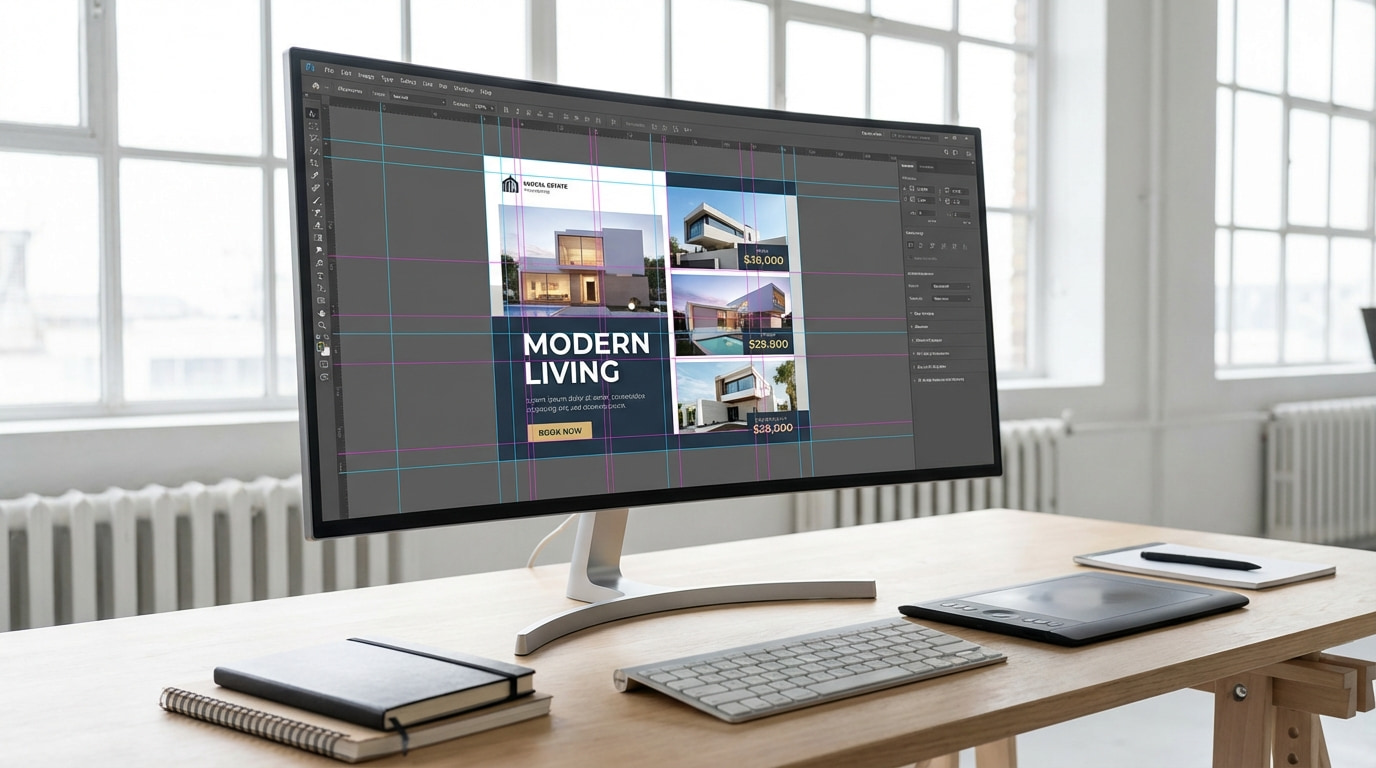
There are exactly two outcomes for a real estate ad: it stops the scroll, or it doesn't.
If it stops the scroll, the buyer reads the headline, looks at the price, feels something about the property, and clicks. If it doesn't stop the scroll, the $8.47 you paid for that impression generated nothing. The ad failed before the copy even had a chance.
Scroll-stopping real estate ad design isn't about making pretty pictures. It's a systematic discipline with specific principles — and in 2026, the agents who apply those principles consistently outperform everyone else in their market on paid social.
The Psychology of the Real Estate Ad Stop
Understanding why certain creative stops the scroll and other creative doesn't requires understanding what buyers are doing when they're not looking at your ad.
They're looking at a friend's vacation photos. A news headline. A viral video. A post from a brand they follow. All of this content has been optimized by sophisticated marketing teams with massive testing budgets.
Your real estate ad competes for attention in this environment. If it looks like a real estate ad — recognizable listing-photo-with-agent-headshot format — the buyer's brain pattern-matches it to "advertisement" and scrolls past before consciously processing it.
The creative that stops the scroll looks different from what buyers expect. It creates a moment of visual surprise, emotional resonance, or information asymmetry — something unexpected that interrupts the scroll pattern and demands processing.
The Four Scroll-Stopping Creative Frameworks for Real Estate
Framework 1: The Lifestyle Lead
Instead of leading with the property exterior, lead with the lifestyle the property enables. A perfectly set dinner table in a stunning dining room. Morning light through a primary bedroom window. A backyard that looks like a weekend retreat. The buyer doesn't see a house — they see a life.
CosmosFX generates lifestyle-led creative by identifying the emotional peak features of each listing and leading the visual hierarchy with those features.
Framework 2: The Bold Data Hook
Real estate data presented unexpectedly can stop a scroll. "This neighborhood's prices have risen 22% in 18 months" as a headline overlay on a beautiful property image creates cognitive interruption — the viewer wants to understand the implication.
CosmosFX pulls current market data and uses it as creative hooks in ad headlines, pairing data with property visuals that make the information immediately relevant.
Framework 3: The Before/After Narrative
Real estate transformation stories perform well across all demographics. A property that was renovated, a neighborhood that's changing, a price-reduced listing that's now priced to sell — the before/after narrative creates engagement through story completion instinct (people want to see how the story ends).
Framework 4: The Localized Curiosity Gap
"The [City] neighborhood most buyers don't know about — yet" or "Why [Neighborhood] is the fastest-moving zip code in [Metro]." These curiosity-gap headlines work because they promise information the viewer doesn't have and imply that the information is valuable.
The Technical Specifications That Make or Break Real Estate Ads
Great creative destroyed by poor technical execution is one of the most common — and most preventable — real estate ad failures.
Every real estate ad needs to meet these technical specifications:
- Primary text: 125 characters or less for mobile-optimized display. The most important information in the first 90 characters (before truncation on most devices).
- Headline: 40 characters maximum for full display on all placements. Leads with the benefit or the hook, not the agent name.
- Description: 30 characters maximum for full display. Used for secondary information or CTA reinforcement.
- Image specifications: 1200x628px minimum for link ads. 1080x1080px for square format. 600x315px minimum (but aim higher). No image should have more than 20% text overlay — Facebook's algorithm reduces distribution on text-heavy images.
- Video specifications: Aspect ratio 1:1 (square) or 4:5 (portrait, optimized for mobile feed). Minimum 15 seconds, maximum 60 seconds for feed ads. First 3 seconds must work without audio — 85% of Facebook videos are watched on mute.
CosmosFX generates ad creative that meets all technical specifications automatically, across all placement types, without requiring agents to manually manage these parameters.
Building a Multi-Variant Campaign Structure
Running one ad version and hoping it works is not a strategy. It's a coin flip.
A properly structured real estate Facebook/Instagram ad campaign tests at least three variables in parallel:
- Creative variant testing: Two to three different lead images or video thumbnails. The visual that stops the scroll makes everything else possible — it's worth rigorous testing.
- Copy variant testing: One version with a feature-led headline, one with a lifestyle-led headline, one with a data-driven headline. Which resonates with your specific audience?
- Audience variant testing: One ad set targeting likely movers, one targeting interest-based real estate audience, one targeting lookalike audience from your database. Which audience responds best to which creative?
CosmosFX structures this multi-variant testing automatically for each listing campaign, allocating budget toward the best-performing variants as data accumulates.
The Landing Page Match Requirement
This deserves its own section because it's the single most common cause of expensive ad failures: sending well-designed ad traffic to a page that doesn't match the creative.
If your ad shows a beautiful kitchen and leads with a lifestyle headline, the landing page must immediately show the same kitchen, the same emotional resonance, and a clear, frictionless path to inquiry. Any mismatch — a homepage, a generic listings page, a Zillow redirect — destroys the conversion momentum the ad built.
CosmosFX generates property-specific landing pages that match each listing's ad campaign. The buyer's experience from ad impression to contact form is seamless, consistent, and conversion-optimized.
Measuring Real Estate Ad Creative Performance
The metrics that matter for real estate ad creative optimization:
- Click-through rate (CTR): The percentage of people who saw your ad and clicked. A baseline CTR for real estate ads is 1–2%. Strong creative achieves 3–5%+.
- Cost per click (CPC): Lower is better, but not at the expense of click quality. A $0.50 CPC from an unqualified audience is worse than a $2.00 CPC from a precisely qualified one.
- Cost per qualified lead: The most important metric. Divide your total campaign spend by the number of genuine buyer or seller inquiries generated.
- Lead quality rate: Of the leads generated by the ad, what percentage scheduled a showing or consultation? This tells you whether your targeting is attracting qualified buyers or just curious browsers.
CosmosFX tracks all four metrics and provides weekly optimization recommendations based on campaign performance data.
Stop burning ad budget on creative that doesn't stop the scroll. Build your next listing campaign with CosmosFX.ai's ad generation system — and see the difference that strategic creative makes.